
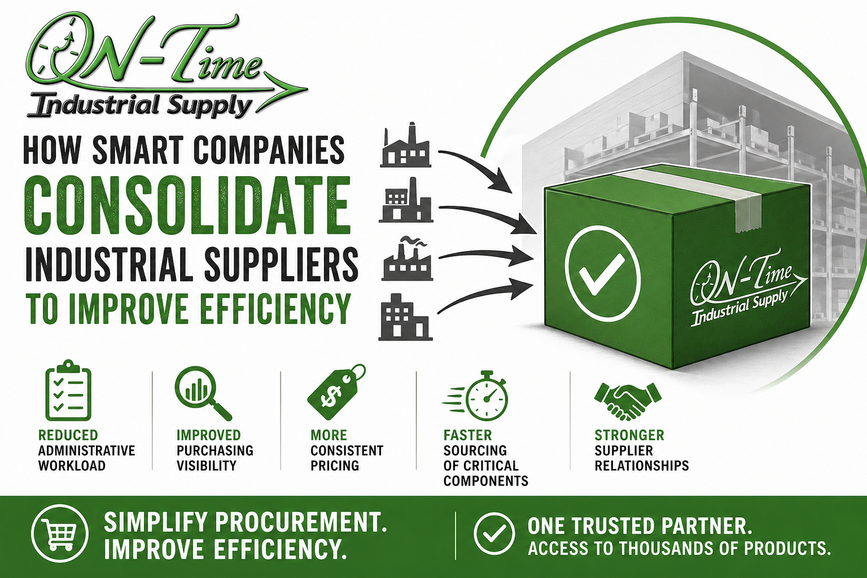
How Smart Companies Consolidate Industrial Suppliers to Improve Efficiency
March 19, 2026
Industrial procurement teams often manage dozens—or even hundreds—of suppliers for maintenance, repair, and operations (MRO) supplies. While this approach may seem flexible, it often leads to unnecessary complexity and administrative overhead.
Many forward-thinking organizations are now focusing on supplier consolidation to improve efficiency and reduce costs.
The Challenges of Too Many Suppliers
Managing a large supplier base creates several challenges for procurement departments, including:
- Increased purchase order processing
- Multiple invoicing systems
- Difficult spend tracking
- Inconsistent pricing structures
- Time-consuming vendor management
These inefficiencies can consume valuable time and resources that could be better spent on strategic procurement initiatives.
The Benefits of Supplier Consolidation
Consolidating MRO procurement through fewer trusted partners can significantly improve operational efficiency.
Organizations that streamline their supplier base often benefit from:
- Reduced administrative workload
- Improved purchasing visibility
- More consistent pricing
- Faster sourcing of critical components
- Stronger supplier relationships
However, successful consolidation requires working with a partner capable of sourcing a wide range of products.
A Smarter Approach to Industrial Sourcing
Rather than limiting procurement to a single distributor catalog, many organizations choose to work with a sourcing partner who can access products across multiple suppliers.
On-Time Industrial Supply provides this flexibility by sourcing from a broad network of manufacturers and distributors, including suppliers like McMaster-Carr, Fastenal, and W.W. Grainger.
This approach allows companies to simplify procurement while still maintaining access to the products they need.
Simplifying Procurement for Industrial Organizations
By consolidating sourcing through On-Time Industrial Supply, companies gain a reliable partner capable of locating the right components quickly while reducing procurement complexity.
The result is a more efficient purchasing process and a supply chain that supports operational success.